
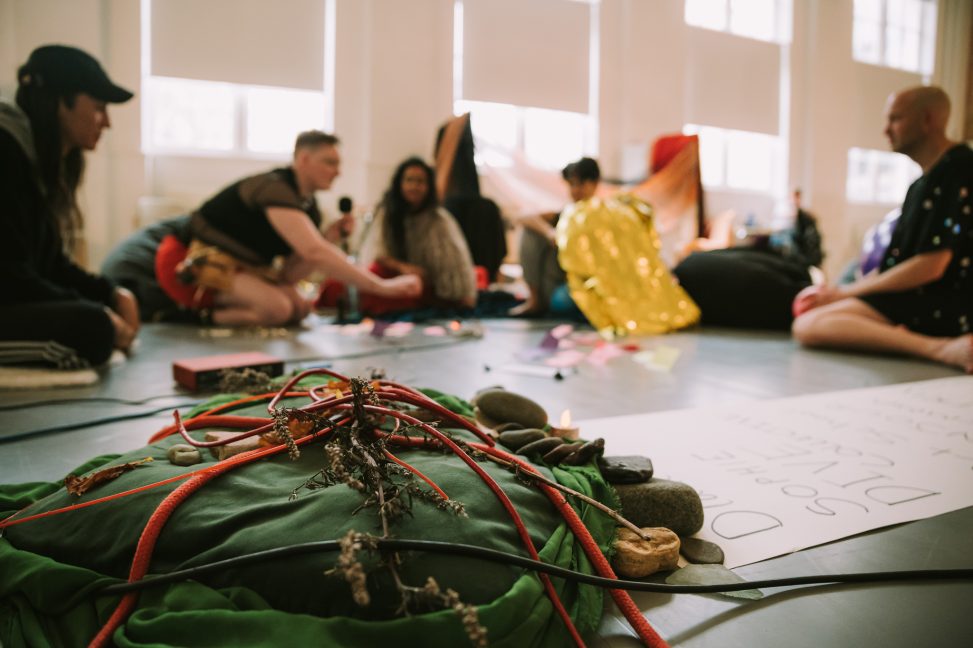
As an Associate Artist with Independent Arts Projects (IAP), Kirsty Biff Nicolson’s work over the past few years has included creative collaborating in community and professional spaces, supporting other disabled artists’ processes along the way. With a practice that spans drag, clown, voice, play and more, Biff’s more recent work has involved cultivating spaces that centre neurodivergence and queerness. In the last year, Kirsty Biff has been working towards cultivating spaces that challenge traditional artistic norms, offering artists a chance to show up as their authentic selves without the pressures of performance expectations or societal masking.
“In capitalism or on a project, even on the most well-meaning projects, often there’s this kind of expectation that you will show up and be really enthusiastic about being there,” Biff explains. “That, I think, means that a lot of masking has to happen, and often, even just the room or environment can be really complicated for neurodivergent folks to be in and the labour that it takes to actually exist in a normal rehearsal room can be difficult.”
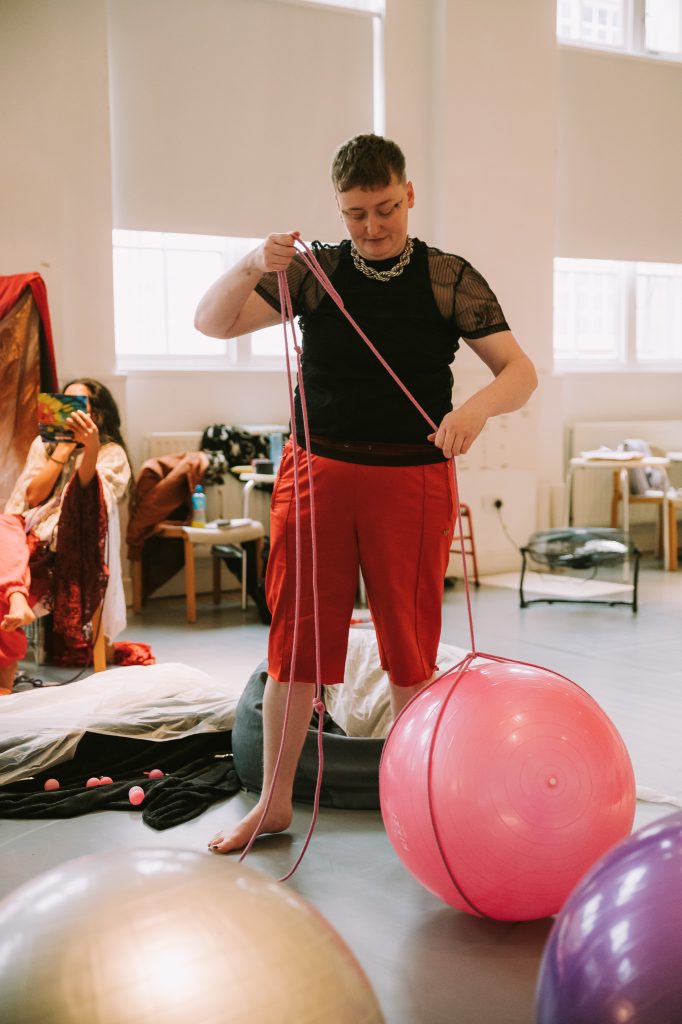
One of Kirsty Biff’s key projects has been developing a neuro queer cabaret; a space that brings together neurodivergent and queer cabaret artists to explore and create in an environment with multiple access points for different modes of being. This project is not just about performance but about fostering genuine presence and participation.
“The work that I did this year is about creating conditions that are different,” Biff continues, “where there could be many ways of being in one space, and the people who are invited into the space might feel comfortable to do that. The hope of the space is that the creativity and the art flows naturally once we’ve created the conditions and embraced them in a way that works for each person.”
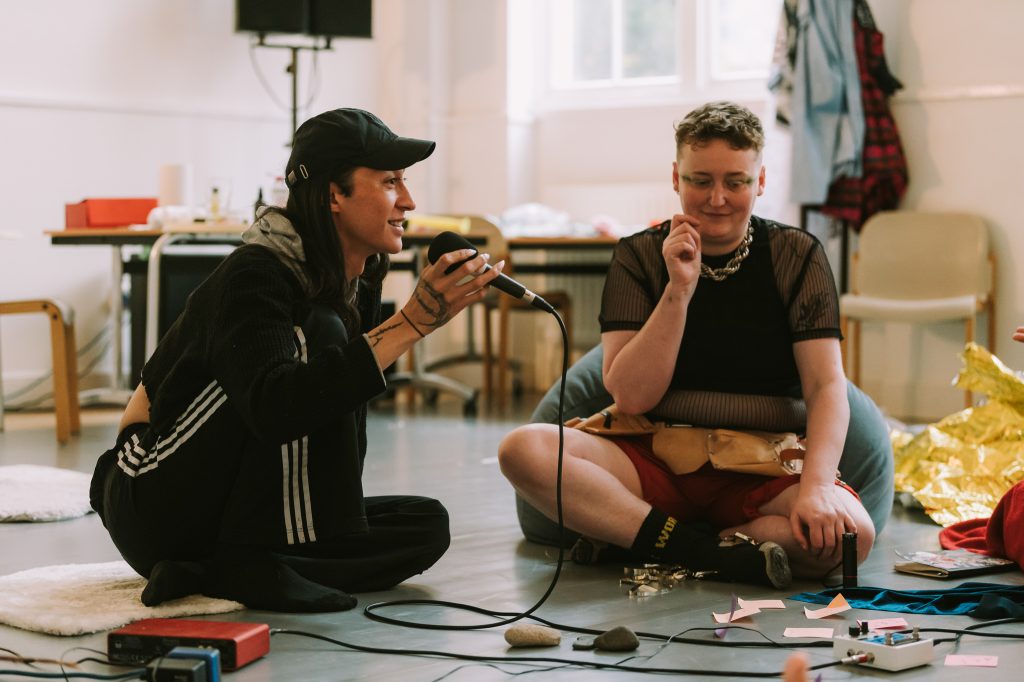
Through a research and development phase, Kirsty Biff and a collective of artists have been exploring methods of working that prioritise comfort, accessibility, and self-expression. The goal was to establish a creative environment where art emerges organically, rather than being forced through rigid structures.
Biff’s journey with IAP began as part of the Sensory Collective, where they were one of six artists creating work with, by and for people who face multiple barriers to accessing mainstream arts. This experience, taking place largely during the pandemic, highlighted the need for more responsive, accessible, and sensory-driven artistic spaces.
“The Sensory Collective allowed me to dive deeper into play, embodiment, and sensory work. Now, as an Associate Artist, I’ve been able to bring those learnings into my work with other trans/gender-non-conforming cabaret artists in a way that I haven’t done before,” Biff shares. “Queer cabaret, while it can be really fun, is often underfunded and inaccessible. I wanted to create a space where queer artists could engage in performance without the usual constraints of late-night venues and overstimulation.”
Reflecting on their work, Kirsty Biff has observed profound moments of unmasking and shared learning within these creative spaces. Each artist involved in the neuro queer cabaret and peer spaces brings a unique practice and perspective, enriching the collective experience.
“I’ve learned from creating the conditions and invitations for people to show up as they are, as much as they can and want to, that there’s a lot of learning through just being together in a way that feels really profound,” Biff notes. “And for me, I’ve walked away with a sense of having had space and time just to be and exist and play in a way that doesn’t often happen.
“And then, of course, because there’s lots of really rich conversation and people with completely different experiences and practices, there are perspectives that I wouldn’t have considered. That’s the hope; that everyone who comes into either the neuro queering cabaret space or the peer space is able to share their practices and perspectives, and we can absorb that in ways that make sense for us.”
This work challenges the traditional notion that art must always have an immediate output. Instead, it prioritises process over product, allowing creativity to flourish organically.
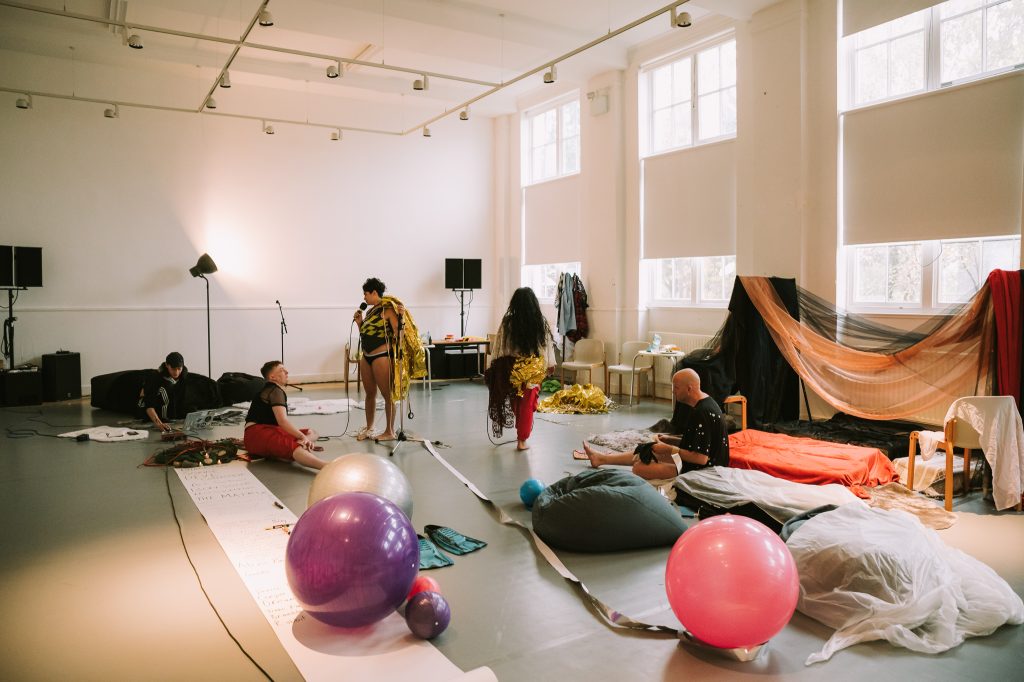
For Kirsty Biff, making artistic spaces more accessible is not just a personal mission but a core aspect of a wider political statement. In a cultural climate where trans/gender-non-conforming and neurodivergent communities face increasing marginalisation, the need for dedicated, affirming spaces is more urgent than ever.
“For this past year and a bit, the drive for me personally in creating spaces like this is that queer performance is often really grassroots, often on the edges. It’s often subversive, and that means that there is limited money, that it’s in the basement of a club at 3am. For me, the desire is to create an abundantly rich, playful space that’s literally during the day, where we don’t have to meet in a club to talk.”
At a time when trans rights are under attack globally, Biff sees these spaces as a form of resistance, a breath of relief amidst ongoing struggles. “A residency isn’t the answer to these systemic issues, but it’s a reprieve. While queer performance and club performances really have changed my whole worldview, I have gained so much from being in queer spaces where people are dreaming liberation through performance.”
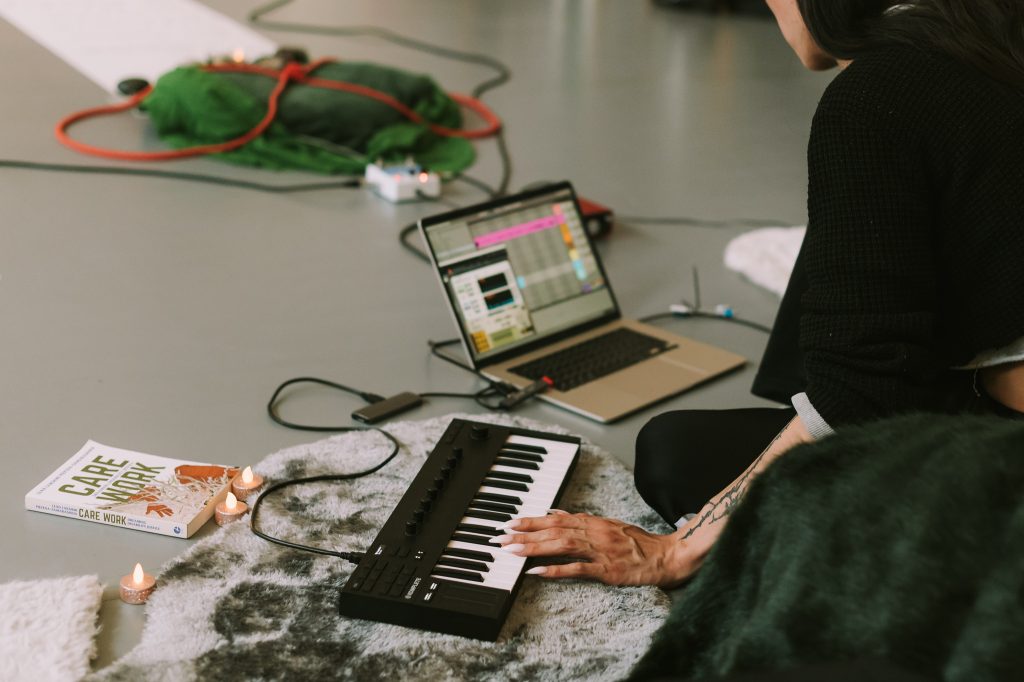
Looking ahead, Kirsty Biff envisions expanding the neuro queer cabaret, allowing for deeper artistic development and broader participation. “The first phase of this project was about exploration,” Biff explains. “I spent time with some of the artists, one on one, either in a studio or over coffee, buying materials for the residency and dreaming it, and playing and trying different ideas. And then we had this kind of coming together of everybody, and it was this incredibly rich week where so much happened.
“I think the next stage will be about coming together again and expanding on the world we began cultivating together. We need a longer residency and more time to develop it and then, we’ll start to invite people in for the world to be witnessed.”
While funding and structural challenges remain, Biff is committed to their vision. “I feel really fired up by having these experiences this year and learning so much from coming together with the artists that have come to work with me on this stuff. And in that sense, I feel really fired up for the future and what’s possible and what’s next.”

Kirsty Biff’s work is contributing to the landscape of performance art that centres accessibility, authenticity, and collective creation. In a world that often demands masking and conformity, their neuro queer cabaret and inclusive artistic spaces offer a powerful alternative – one where people can truly be themselves and create from a place of freedom.
“I feel unsure of how this long, slow way of working sits in the “real world”,” Kirsty says. “But what I do feel more sure about as an artist is creating conditions and spaces with the people that come into the room, that can be really gentle, rage-full, and explosively beautiful at the same time. So I feel like, in that sense, I understand what kind of work I want to be doing and what kind of spaces I want to create, and I don’t really want to compromise on that anymore.”
For more about We Dream Here, see independentartsprojects.com/we-dream-here/
Arusa Qureshi is a writer, editor and music programmer based in Edinburgh. She is the current Editor of Fest and the former Editor of The List and writes mostly about music, most recently Flip the Script – a book about women in UK hip hop, published by 404 Ink. Her work has appeared in the Scotsman, Clash, the Guardian, GoldFlakePaint, Time Out, the Quietus, NME and more. She chairs the board of the Scottish Music Centre, sits on the board of the Music Venue Trust and is the co-curator of the award-winning Amplifi series at Edinburgh’s Queens Hall. arusaqureshi.com