

Arusa Qureshi talks to Shiori Usui about facilitating sensory workshops in water exploring music and sound in Dundee.
Swimming and spending time in water is widely known to be restorative, both physically and mentally, but water can also be used as a unique creative stimulus. In autumn 2024, composer Shiori Usui highlighted this when she endeavoured to transform the swimming pool at Kingspark School in Dundee into an unconventional but deeply expressive creative space. Working alongside visual artist Kirstin Abraham and sound engineer & artist Nik Paget-Tomlinson, Usui facilitated a series of workshops that invited young disabled people into a world of sound, music, and water-based play. Using live music, tactile instruments, and an underwater speaker, participants explored new ways of being together in water – discovering sound not just as something we hear, but as something we feel.
“I’ve been trained as a composer, and I’ve written a lot of music for concerts, so for orchestras and ensembles,” Usui says of her background in composition. “I sometimes focus on music inspired by human bodies, and tend to be interested in exploring timbres of music, such as exploring different sound colours.” Her creative work often ventures beyond traditional performance spaces, encompassing improvisation, experimental vocal techniques, and theatre.

That boundary-pushing curiosity is what led her to getting involved with IAP, first as a performer in the sensory theatre show Sound Symphony by Ellie Griffiths. “That show really inspired me,” she recalls. “It made me want to create something myself, with and for disabled people.” After completing a period of R&D supported by Imaginate, Usui was approached by IAP to further develop this project and the sensory music experience designed specifically for disabled young people, staged inside a hydrotherapy pool in a Dundee school.
The theme of symbiosis – how different beings co-exist and interact – became a guiding principle. Usui worked with Abraham and Paget-Tomlinson to incorporate a range of accessible elements: live instruments, an underwater speaker, light-up torches, and even an underwater camera. But it was the human element that proved most powerful.
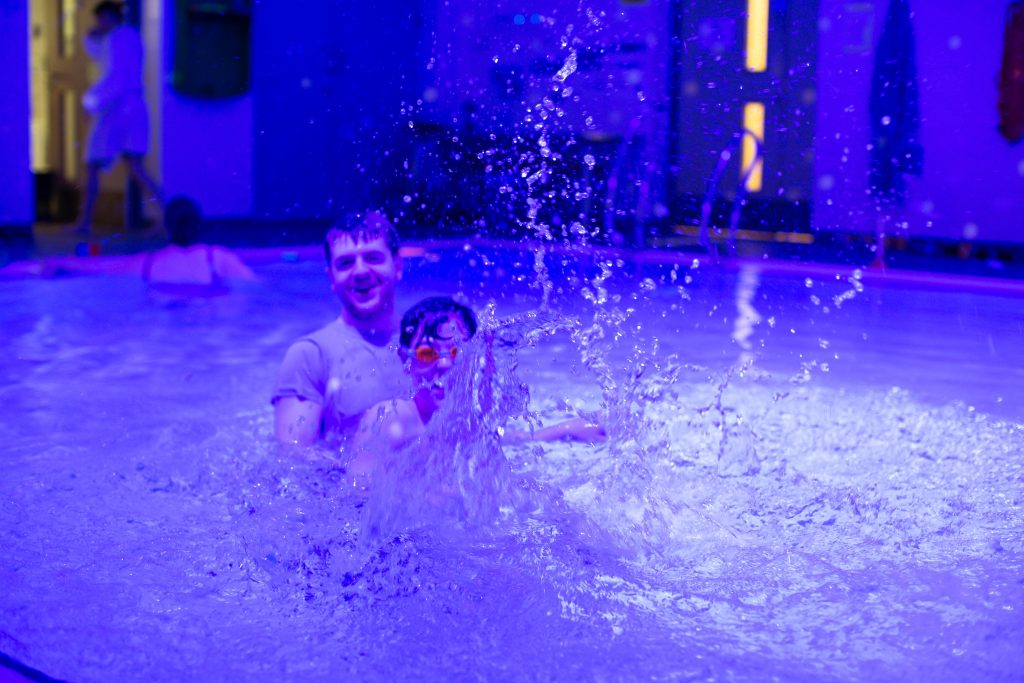
“In the end, human contact was the most important thing,” Usui reflects. “We wanted the young people to feel ownership of the experience.”
To build that sense of connection, the team invited school staff to complete “About Me” forms on behalf of each participant, gathering insights about their preferences, triggers, and communication styles. These shaped the workshops, allowing the team to tailor activities to each individual.

Among many meaningful interactions, one moment stood out. After the final workshop, one young participant remained by the poolside, playing a slide whistle long after the session had ended. “It was a genuinely improvised moment,” Usui says. “Some of us responded to that musically, and I felt like that was one of the highlights for me. Because, I think my hope is that that happened because he was feeling comfortable, and we somehow managed to establish some sense of trust between him and us.”
For Usui, such non-verbal exchanges can speak volumes. “It’s not oral feedback, but it’s, for me, an indication that maybe he enjoyed the workshop.”
Projects like this one aren’t just artistically enriching – they’re necessary. “Mainstream arts tend not to take into consideration that there are many ways that people can enjoy arts, and I don’t think it’s healthy as a society to only offer what society thinks as the standard way of being or existing or appreciating art,” Usui explains. “If you don’t fit in, you have to struggle, and I think that’s not right.”

She emphasises the importance of bringing art to people, especially those who may face logistical or sensory barriers to attending traditional venues . “For me, creating a show in the school was important, and hopefully breaks some of those barriers.”
Working with IAP has also helped Usui to further imagine what is possible in her own practice. From sourcing an underwater speaker from the US to attending a sensory theatre conference in England, the support she received helped open up numerous possibilities around her work. She also valued the personal connection IAP fostered among artists. “Because I work as a freelancer, it was nice when IAP asked if I wanted to join the Slack group, and people who worked with IAP could send messages to each other. There was a group channel so there was a sense of belonging that I sometimes long for as a freelance artist.”
Recently, Usui was on tour with Float, a theatre piece for babies and grown-ups, and she’ll then be performing in another sensory theatre production. And in the near future, she hopes to develop her pool-based show further building on what she’s learned to deepen the impact and accessibility of her work.
“I like the encounter of different ways of seeing and experiencing the world,” she says. “It makes me richer as a person.”
Lead Artist Shiori Usui
Collaborators Kirstin Abraham, Nik Paget-Tomlinson
Guest Artists Ceylan Hay, Greg Sinclair, Claire Willoughby
Documentation Jassy Earl
With enormous thanks to the young people and staff at Kingspark School in Dundee.
This project was supported through the National Lottery Extended Programme Fund from Creative Scotland and Oily Cart.
Arusa Qureshi is a writer, editor and music programmer based in Edinburgh. She is the current Editor of Fest and the former Editor of The List and writes mostly about music, most recently Flip the Script – a book about women in UK hip hop, published by 404 Ink. Her work has appeared in the Scotsman, Clash, the Guardian, GoldFlakePaint, Time Out, the Quietus, NME and more. She chairs the board of the Scottish Music Centre, sits on the board of the Music Venue Trust and is the co-curator of the award-winning Amplifi series at Edinburgh’s Queens Hall. arusaqureshi.com